Thursday, November 21, 2013

The Pillars of Milan

I've just finished The Pillars of the Earth by Ken Follett. The book is set in 12th century England, during the years of anarchy that came as a result of a dispute over the throne between Empress Maud, the daughter of the dead King Henry I, and her cousin, Stephen. Maud had the support of those who saw her as the true heir - she was, after all, the king's daughter. But Stephen gained support from those who saw Maud as unfit to rule because she was a woman. Blahblahblah, historical ramblings. Anyway, the story follows the lives of various characters and revolves around the building of a cathedral.

That probably sounds extremely dull to most of you.

Admittedly, it even took me a few chapters to really get into it, but I promise you won't be able to put it down if you give it a chance. The characters are masterfully intertwined in surprising ways and you'll find yourself celebrating and commiserating with them as they attempt to finish the cathedral amidst political and religious schemes and strife. What has stuck with me throughout, however, is the silent star of the book - the cathedral itself.

In the past two and a half months I've lost count of the number of cathedrals I've seen. Their size, intricacy, and beauty never fail to leave me in awe. I've literally spent hours making my way down the nave and the aisles, admiring each chapel and seeking out various architectural features I could identify. I have a deep appreciation for cathedrals, but it's always been, for the most part, academic. Pillars of the Earth has given me a more intellectual appreciation. It's one thing to walk through a cathedral and admire it for purely artistic purposes, or even to feel deeply moved, religiously speaking. But to really understand how and most importantly, why these amazing structures were built puts a whole new spin on what you're looking at.

If you looked at Christianity as a line on a graph over the centuries, one of its highest points would be the medieval period. The unshakeable belief in God, heaven, and hell that these people held is the sole purpose for building massive churches. Well, that and the income they could generate for a town, but really, 99.99% of it was driven by religion. The taller the building, the closer to God - people honestly believed that this was true. They also believed that creating something on such an enormous scale specifically for God would undoubtedly win his favor, thus abolishing their sins and securing their place in heaven. In Pillars of the Earth, the master builder, Tom, is driven by a deep desire to create the most beautiful cathedral in England, but also very much by his wish to give his wife, who died and is buried in unconsecrated (unholy) ground, a place in heaven.

"My first wife... Agnes... she died without a priest, and she's buried in unconsecrated ground. She hadn't sinned, it was just... the circumstances. I wondered... Sometimes a man builds a chapel, or founds a monestary, in the hope that in the afterlife God will remember his piety. Do you think my design might serve to protect Agne's soul?"

Philip frowned. "....is this design the best thing you could offer God?"


"Except for my children, yes."


"Then rest easy, Tom Builder. God will accept it."


Now, I'm certainly not the most religious person you'll come across, but even I have to admire how sincerely the people of this time believed. Were it not for that unshakeable faith, I doubt these beautiful churches would ever have been built.

So God accounts for most of the why, what about the how? I'm sure I'm not the only person who has found themselves wondering, "How on earth did people a thousand years ago figure out how to build such structures?" The miracle of it all is made even more apparent by the relative simplicity of our modern buildings in comparison. The answer is simple: years and years and YEARS and DECADES, sometimes CENTURIES of hard labor.

The aptly named Tom Builder in Pillars of the Earth secures his position as master builder of the cathedral thanks to his knowledge and understanding of masonry and the mathematics of building. The engineers of centuries past were, in many cases, as brilliant and knowledgeable as ours today.

Tom designed the three levels of the nave wall - arcade, gallery and clerestory - strictly in the proportions of 3:1:2. The arcade was half the height of the wall, and the gallery was one third of the rest. Proportion was everything in a cathedral. The tower should be either one and a half times the height of the nave or double it. It would give the building an attractively regular profile, with the aisles, the nave, and the tower rising in equal steps, 1:2:3. 

These people understood what would look 'good' and exactly how to implement it; they knew what would allow them to build in a straight line, or create a pointed arch, add windows, or solve difficult problems that often arose while building. They knew and carried out all these things without the aid of our modern technology.

He stood on the scaffolding far above the ground, staring close-range at the new cracks, brooding. He needed to think of a way of bracing the upper part of the wall so that it would not move with the wind. he reflected on the way the lower part of the wall was strengthened. In the outer wall of the aisle were strong, thick piers which were connected to the nave wall by half-arches hidden in the aisle roof. The half-arches and the piers propped up the wall at a distance, like remote buttresses. Because the props were hidden, the nave still looked light and graceful. He needed to devise a similar system for the upper part of the wall....if only he could build piers and half-arches to support the clerestory...

The above passage describes a builder's dilemma regarding the way the height of his cathedral (taller than any other at the time) required additional support, for cracks had been appearing throughout. He needed to add this support without compromising the aesthetic integrity. He later solves the problem by developing flying buttresses - a common feature on many gothic cathedrals. Though the book provides a fictional account of the problem, a similar scenario in real life likely pushed the real inventor of flying buttresses to reach the same conclusion.


Above is the buttressing on Westminster Abbey in London. Each outer pillar reaches a point inside the wall, providing support to the structure. This support isn't enough, however, when cathedrals are built taller. Additional buttressing is required for the upper portions; thus, flying buttresses were utilized, like on Notre Dame in Strasbourg, pictured below. The higher portion of the church is supported by the half arches that jut out and connect to the original lower supports.


Innovations aside, even the most simplistic cathedral could not take shape without the basic materials. Take another look at Westminster Abbey and Notre Dame above; all of that stone had to be quarried by hand and transported to the building site via oxen and carts, then cut with hammers and chisels into hundreds of perfectly shaped pieces for building walls, pillars and arches and sculpting angels, saints, and other decorative pieces. Timber had to be cut from forests and transported to the site as well. As the church grew upwards, wood and stone would be moved from the ground up, piece by piece with pulley systems. There were no cranes, no heavy machinery to assist.

Cathedral building employed hundreds of people and often helped villages prosper into cities. When finished, they would become the churches that held the bishop's throne and often the remains of a particularly important saint. People would flock from all around to hear the bishop say mass or just to kneel at the bones of a saint. There is really no modern day equivalent to describe the sheer importance of the way the people's devotion to God manifested itself in these impressive churches during the Middle Ages.

I suppose that's the point I'm trying to get at here. These buildings weren't created because the town wanted something nice to look at. Cathedrals were built to worship God. Cathedrals were made enormous to please God. Cathedrals were decorated beautifully because God was worthy of only the most glorious of structures. Because of this driving force, the people who lived thousands of centuries ago managed to find innovative techniques to carry out the construction, without the modern technology we use today to create, in my opinion, many less beautiful buildings. I dare you to walk into any European cathedral bearing all of that in mind and not be at least a bit moved, humbled, and awed at what you're seeing.

So, after this incredibly long introduction, let's take a look at Milan's own cathedral, shall we?  Awhile ago I posted about the exterior of the Duomo. It's extravagant, intricate, and beautiful.


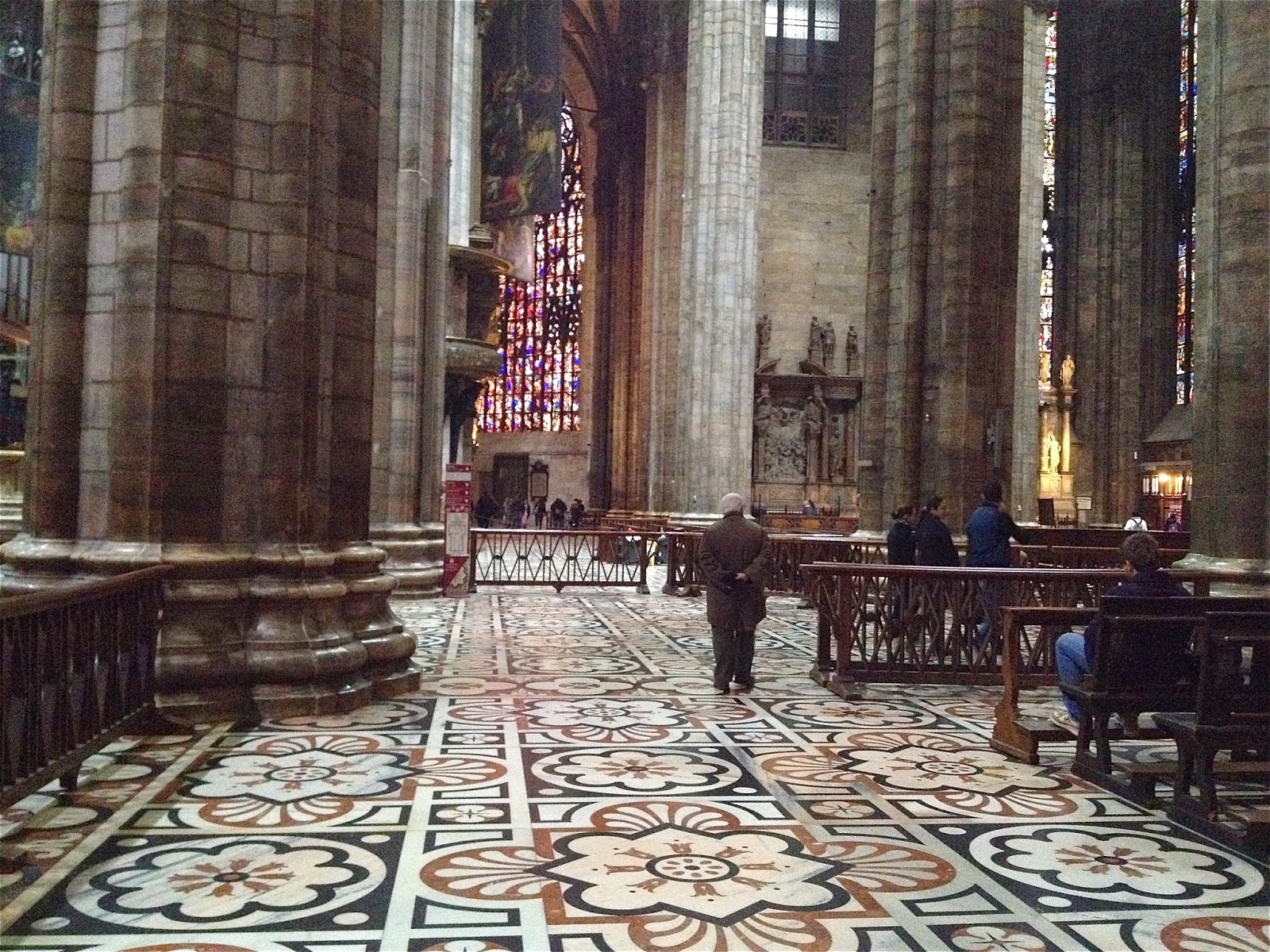
The inside is no different. Sadly, I must make a disclaimer here; none of my amateur photography does justice to the sights of Italy, and these photos are certainly no exception. Since you can't use flash inside the cathedral, all of my photos taken with my camera turned out dark, so these are iPhone photos. You get the gist of the place, at the very least. Nothing compares to actually walking inside, anyway.


Milan's Duomo boasts rows of massive pillars. Like many Gothic cathedrals, each pillar is surrounded by shafts, giving it a more impressive look overall.


Each pillar is topped off with carved capitals featuring various religious figures.


The shafts that surround each pillar seemingly continue on their way up beneath the decorative capitals and emerge again above them, where they branch off, cross the vault of the nave, and join up with the corresponding shaft from across the way. The square/triangle pattern that results is called a ribbed vault. The very first cathedrals were built with boring barrel vaults - basically just a regular old arched ceiling. Ribbed vaulting was an innovation that allowed cathedrals to be built higher than ever before.


The side aisles of many cathedrals are lined with smaller chapels dedicated to a particular saint or person. Above is a rather large shrine to Saint Something-or-Other, complete with stained glass windows, which were another innovation of Gothic churches.


Size comparison: that random man is barely taller than the base of the pillar.


And like any good Christian church, Milan's Duomo is the final resting place of many esteemed religious men. Yes, these are their real bodies, preserved and enshrined and on display. Rotting popes really liven the place up.


Pictured above is the crypt of San Carlo, the archbishop of Milan in the 16th century. He helped lead the counter-reformation in Italy and became a saint following his death.


It really does make me a bit sad that buildings like this aren't made anymore. The art of cathedral building is about as dead as that pope up there. Fortunately, these churches have stood the test of time and they can still be appreciated today - even more so, when you bear in mind how utterly remarkable it is that they were built in the first place. I'll end this how I started it; cathedrals are awesome, and Pillars of the Earth is a great book which I highly recommend it to anyone who has even a remote interest in historical fiction. And who knows, it may inspire you to jump the pond real quick and see some European cathedrals for yourself.

Labels: , , , , ,

Friday, October 25, 2013

Verona: Castelvecchio

Castelvecchio (literally: Old Castle) is an early Renaissance fortress built alongside River Adige in Verona. In many ways, it's a twin to Milan's Castello Sforzesca. Construction on both red brick castles began within four years of each other in the late 14th century. Both were built for the reigning family of that time - in Castevecchio's case, the Scaligeri. Like Castello Sforzesca, it was originally intended as a fortress, became barracks and training grounds for various foreign legions over the next few centuries, and today, it houses a museum.


Castelvecchio is home to a spectacular collection of northern Italian art, spanning from the Middle Ages to about the late 18th century. As you wander through the ancient fortress, pieces are organized chronologically, so you really get a feel for the evolution of Italian painting over roughly 1,000 years. The sculptures and paintings are displayed in a more liberal fashion than most museums - pieces are hung on the wall of course, but they are also suspended from the ceiling or stand alone in the middle of the room. The ability to stand centimeters from a fragment of fresco circa the 5th century made for a great experience in the museum... although I couldn't help but feel a bit wary of the many guards' constant eyes on my back as I snapped away with my camera.


Though photography was permitted, flash was not allowed - so I apologize for the terrible quality of the photos. That said, here is a selection of some of my favorite pieces in the collection.


"Christ with Peter and Paul", Pelegrinus, 730. Something that always puzzles me about the evolution of art in Italy - particularly sculpture - is how the portrayal of human bodies and faces can go from the classical perfection of ancient Rome to the cartoonish style shown here. For comparative purposes, here's Emperor Antonius Pius from about 86 AD - over 600 years before Jesus and his buddies up there. He looks a bit more realistic, in my opinion.


Unknown subject, unknown artist, circa 8th c.


Christ on the cross, unknown artist, circa 8th c.


"Battle of the Horsemen," Veronese painter, 14th c.


"Saints Gregory and Bartholomew," Tuscan painter, 14th c.


Unfinished portion of the "Coronation of the Virgin " fresco in the tomb of Aventino Fracastoro, unknown artist, 14th c.


"Thirty Stories of the Bible," from the convent of Saint Caterina, Veronese painter, 14th c. This comic-book style arrangement was a common form of storytelling in the Middle Ages.


"Presentation of Christ," Veronese artist, 14th c. You may have noticed that artists responsible for most medieval works are nameless and unknown. At best, only the city of origin and a date can be estimated. Compare this to Renaissance art and you'll see a stark difference. Leonardo da Vinci, Michaelangelo, and Raphael were household names and cities took immense pride in what they created. From a historical standpoint, it's a testament to how the importance of art and its role in society has evolved over time. Tough luck for the medieval painters though, whose works are largely uncredited. 


"Polyptych of Boi," attributed to Altichiero, 1369. The prefix 'poly' means many, and 'tich' is the Latin term for wall, thus, polyptych means 'many walls.' Polyptychs are simply paintings made up of many panels. Most polyptychs served as altarpieces which were decorated on both sides, so when the altarpiece closed, an entirely different scene was shown. Though not a part of the Castelvecchio collection, the "Ghent Altarpiece" by Flemish painter Jan Van Eyck is a beautiful example of this. It's also the source of relentless studying in my attempt to memorize each panel's subject matter for an exam. At the time, of course, I thought to myself, "When will I ever use this information again!?" But look, I've accurately identified a polyptych! Dad, that tuition money was worth it after all.


View when opened...


...and closed. 


"Madonna and Child," unknown artist, 1345 AD


"Crucifix," Jacopo Bellini, 1464. Bellini is not as glamorous or well-known as his famous Renaissance counterparts, but he was responsible for bringing the early Renaissance style of painting from its birthplace in Florence to northern Italy.


"Saint John the Baptist and Saint Michael, Archangel," from the workshop of Zavattari, 1456.


"The Legend of Orpheus," German painter, 16th c. Orpheus was an ancient Greek musician and poet who had a legendary ability to charm all living things with his music. In this particular portrayal of his musical finesse by a German painter, the human form has made a bit of progress compared to some of the previous examples. Yet, the animals and landscape still have an unnatural feel to them. The artist has also made a valiant attempt at perspective, but the overall affect is still somewhat strange to our modern eye.


"Ancona Fracanzani," (translation?) Giovanni Badile, 1373. Mary, why so dour?


"Augustus and Sybil," Giovanni Maria Falconetto, 1501. 


"Deposition of Christ," Liberale da Verona (literal translation: a liberal from Verona, but in this case it's the artist's actual name), 1479. Deposition of Christ is an image that you can find everywhere in medieval and Renaissance art. It's a common religious theme - the removal of Christ from the cross - and has been portrayed by countless artists. Popular 'themes' such as this make it easy to compare techniques between two paintings of the same subject matter from different time periods.


"Sphere of the Trinity," Francesco Morone, 16th c.


Unknown title, unknown artist, unknown date - because I forgot to record it. Probably late 16th century.


"Salome," Unknown artist, mid 16th century. No, Salome does not refer to a man's decapitated head being likened to salami. Rather, Salome is the name of King Herod's daughter, and the unfortunate head belonged to St. John the Baptist. As the story goes, St. John was imprisoned by Herod after chastising him for divorcing his wife. On Herod's birthday, his daughter Salome performed a dance for him, which he liked so much he promised her anything she wanted. Naturally, she asked for St. John's head on a platter. This is another biblical image that's duplicated often; this is probably the sixth or seventh time I've seen it around. Yet I had never heard this story before coming here, seeing paintings of it everywhere, and finally looking into it. I'm no fan of the bible, but I'm not sure how a decapitated St. John could have escaped the general scope of my religious knowledge. I mean come on, the man's head is just casually on a plate!


"Deposition," Paolo Caliari, late 16th century. Another example of the deposition image, but painted nearly a hundred years after the first one I showed:


Same image - subtle differences. Faces in the latter painting look more realistic, more mournful. Christ's body is more detailed and more muscular, showing that advances in basic anatomical knowledge had been made. The background is shown more realistically as well; the subjects and the landscape are almost on the same plane in the first painting, whereas the subjects are clearly the focal point and the landscape is clearly in the background in the second.


"Christ Shown to the People," Paolo Farinati, early 17th century. It's fairly evident that this painting is much better than the first few I've shown. (Technically speaking, at least. Let's not get into that silly argument about what defines works of art as "better" or "worse.") You can see the tension in Christ's body and can get a good sense of feeling and movement. The idea of perspective is carried out well to give the viewer the feeling that they are in the painting rather than just looking at the painting, like in this previous example from nearly 300 years prior.


When we think of our modern world, we often find ourselves wondering, "What did people do before cars? Or cellphones?" Sometimes I wonder, "What did people do before perspective?" Really, what were people's reactions when they saw their faces portrayed with buggy eyes and abnormally large foreheads? How did the ability to properly duplicate a human face on canvas (or in stone) evolve?  How were techniques like perspective and angles and shadowing discovered?

While I don't have the answers to those questions, I do know that very few people find them as fascinating as I do. So, if you've stuck with me to the end of this post, I thank you.

Labels: , , , , , , , , ,

Wednesday, October 16, 2013

Verona: Past and Present

One thing I really loved about Verona is how the past still functions in the present. Many of the historic sites or places have been adapted to fit modern needs while still maintaining their "oldness," so to speak, and there are random bits of historical architecture everywhere you look. For example, Roman and medieval portals - entrances to the city - still stand at random points in the street - though you no longer need to pay the toll in order to pass.


Upon entering the city center through one of these portals, you'll see the ancient Roman arena. Built in 30 A.D. on a piece of land that was, at the time, a few miles outside the Roman city center, its first few centuries of existence saw lots of bloodshed. Gladiator battles pitted man vs. man and man vs. animal in Roman times, and public beheadings took place there during the middle ages. Thanks to a newfound appreciation for the arts cultivated during the Renaissance, the arena started to be used for opera performances. This trend continues today, and it has also seen the likes of One Direction, Duran Duran, The Who, and Whitney Houston. The arena can fit up to 25,000 spectators and as everyone knows, is the blueprint for our modern stadiums. 


The arena's entrance fee is 6 Euros, but if you have a student I.D. that still remotely looks like you and are capable of mumbling "Sono studentessa/o," you can get in for 4.50. Visitors are free to climb up and all over the seats (the lower half of which have had cushions added to them). But... to be completely honest, I was a little disappointed. When it comes down to it, it's just a massive stone complex, and it lacks the romance and intrigue of a well-known arena like Rome's Colosseum. To be fair, it may well have been the horde of teenagers belting out awful Disney songs in Italian on the stage in the center that tainted my arena experience. Oh, and just a friendly hint: those "gladiators" posing with that poor little boy in the above photo are not affiliated with the arena. They're just a local group that prey on tourists by overcharging for a gimmicky photo. Stay away! 

Right outside of the arena is a relatively small, thin column positioned rather randomly in the piazza. 99% of people probably just walk past it without a second thought. It's called a devotional column, and most piazzas had one back in the day (back in the day in this case = middle ages). People would gather around the column to ask for blessings for the market. The one in Verona is still intact, and today people gather around it to gawk at the street performer posted up beneath it, who I strategically did not photograph because I found him frightening. 


Speaking of markets and piazzas, Verona's Piazza Erbe is my favorite piazza I've seen so far. You can make absurd statements like "I have a favorite piazza" when you live in an Italian city. A piazza is just a square, and Italian cities have loads of them. Piazza Erbe is probably one of the few that looks very much like it used to centuries ago. It dates back to the Roman times, when it functioned as a forum - a meeting place for politics and law - and of course, as a marketplace. The fountain in the middle of Piazza Erbe has been bubbling for nearly 2,000 years, and the statue of a lion that sits at the northern end has been there since 1405, when Venice conquered Verona. 


Today, Piazza Erbe is still home to a market of sorts - vendors line up to sell fruits and vegetables, pastries, handmade leather bags, and a few "I visited Verona!!" t-shirts and keychains. You can also find a plethora of tasty restaurants and gelaterias surrounding the square. Here, I found a deliciously cheap sandwich and the first of too many gelatos. 


Do you see that tower in the upper left corner of Piazza Erbe? It's one of the few remaining from the Middle Ages, back when the town was full of them. Noble families built towers to show off their wealth to one another. If you see a bell tower that either stands on its own or is connected to a smaller structure that isn't a church, you can be almost certain it was constructed by an important family. Torre dei Lamberti, or the Lambert Tower (built in 1172), is another that's still standing in Verona, and for 6 Euros you can climb 245 steps to the top. 


Clearly, it's worth the climb. Verona's terra-cotta rooftops seem to go on for miles, and the Italian Alps make for a stunning backdrop. The Lambert Tower sits in the Romanesque Palazzo della Ragione, which is home to yet another beautiful and well-preserved piece of architecture: an outdoor staircase, completely original and intact since its construction in 1447. I stood at the base of the staircase for fifteen minutes to get a photo of it without people strewn all over it. As I watched person after person lay on the banister and pose with freakish arm gestures as if to say, "Yeah, man, look at me! I'm on a staircase, b*tch!" I wondered how many of them even knew anything about what it was they were standing on. In other words, STOP POSING LIKE THAT, YOU'RE DISGRACING THE STONES WHERE VERONA'S ELITE ONCE TROD!! Ugh.


But anyway. Just outside Palazzo della Ragione is Piazza dei Signori, or "The Lord's Square." This little area is a melting pot of architecture; the buildings surrounding it span from the middle ages to the Renaissance. You can easily tell which are from the Renaissance; just look for the frescoes. Like medieval nobles and their towers, wealthy Renaissance families did their bragging with exterior frescoes. I find it pretty remarkable that much of what can be seen today is, for the most part, original and unrestored.  


In the middle of Piazza dei Signori stands a somber looking Dante Alighieri. Quick history: this is indeed the Dante behind The Divine Comedy, the self-narrated tale of his journey through hell and purgatory to reach heaven. It was the first literature to be written in something other than Latin, the language of the church. Dante took a hodgepodge of spoken dialects and called the written result "Italian." For this reason, it was accessible by the masses and wildly popular. It also depicted several well known popes and other church figures in less than flattering situations (Pope Boniface VIII buried up to his head in the 8th circle of hell, for example) and for this reason, Dante was exiled from Florence to Verona, where he lived out the rest of his life. As Dante became a literary genius in history's hindsight, Florentines tried to reclaim him as their hero and even built him a tomb in the 18th century. Verona has maintained a tight grasp on him though, and his body lies not in Florence, but in nearby Ravenna where he died. 


On the topic of tombs, literally right around the corner from Piazza dei Signori are the Scaligeri family tombs. Remember how Florence had the Medici family, Siena had the Borghese, and Milan had the Sforza? When Italy was divided into kingdoms, Verona and the surrounding area had the Scaligeri. Their bodies still lie in the fanciful tombs created for them in the 15th century, which are surrounded by the original wrought iron fences. Not a bad place to rest for all eternity! Just watch out for what looks to be the first version of barbed-wire, though. 


Speaking of resting, this might be enough history for one post. But there's still alot more to see in Verona! Let's spend the night back in Piazza Erbe and pick it up another day, shall we? 


Labels: , , , , , , , , ,

emilan

emilan