Thursday, January 9, 2014

Hotel Reviews: Milan, Florence, and Rome

Something I never write about on here is where you should stay if you're visiting Italy. That's because I usually bop through a town in one day; being the stingy traveler that I am, I'd rather walk around for 7+ hours and cram everything into one day than pay for a hotel or hostel. But in traveling with my family over the past week, hotels were obviously necessary. We spent two and a half days based in Milan, three and a half days based in Florence, and four and a half days based in Rome - plenty of time to decide whether or not the hotels we stayed in were worth a recommendation or not.

Like many of my travel decisions, I turned to Rick Steves for his God-like advice while choosing hotels, and 2 out of the 3 we stayed in came from his Italy book. I began booking for our late-December trip in mid-October, and I wouldn't suggest waiting much longer than that if you plan to visit during a busy tourist time (unfortunately, Christmas/New Years is definitely a busy tourist time).

Milan - Hotel Palazzo delle Stelline

Palazzo delle Stelline is a good choice if you prefer to be farther away from the busy, touristy city center of Milan. Because 99%  of Milan's main attractions are clustered around the Duomo, so are 99% of the hotels. The majority of these are gimmicky and overpriced. You might think you're getting a good deal given their location, but you can save 100 Euros by choosing something a little less flashy and a little further away.

Palazzo delle Stelline is a quiet hotel in Milan that used to function as a monastery. You won't wake up next to the Duomo, but you will be right across the street from Santa Maria Delle Grazie, home of Da Vinci's Last Supper, and a ten minute walk from Cadorna Station, where you can access any of Milan's three metro lines and an express train to Malpensa Airport. To get to the Duomo area, it's just a 15 minute walk in more or less a straight line. You'll be amongst locals and have plenty of bars and cafes to pop into along your way - you'll notice that they're considerably less expensive and less crowded further away from the Duomo area.


TripAdvisor has been a bit too harsh to Palazzo delle Stelline, in my opinion. Most complaints are directed towards "boring rooms which lack charm," and "meager breakfast offerings." Like I said, if you want a lavish room, book near the Duomo, but be prepared for a lavish price. Our rooms at Palazzo delle Stelline were tidy, clean, had comfortable beds and functioning bathrooms. You don't need much more when you're spending the entire day outside sightseeing, anyway. As for the breakfast, I think we all agreed that Palazzo delle Stelline had a pretty good spread. You'll find the typical Italian breakfast fare; croissants and pastries, slices of cheese and ham, coffee and orange juice - but there's also a good selection of American fare, like bacon, eggs, cereal, yogurt, and fruit.


Single room: around 100 Euros/night
Double room: around 175 Euros/night
Suite: around 205 Euros/night

Florence - Locanda de'Ciompi

We were all rather impressed with Locanda de'Ciompi. With only 5 rooms, it's less of a hotel and more of a bed and breakfast. I'm surprised we managed to get two rooms during the busy holiday time.

The owner is Alessio, and we all found him to be incredibly warm and welcoming. He clearly would have been quick to answer any of our questions - had we had any. The rooms are spacious and very charming, and the bathrooms were very nice as well.
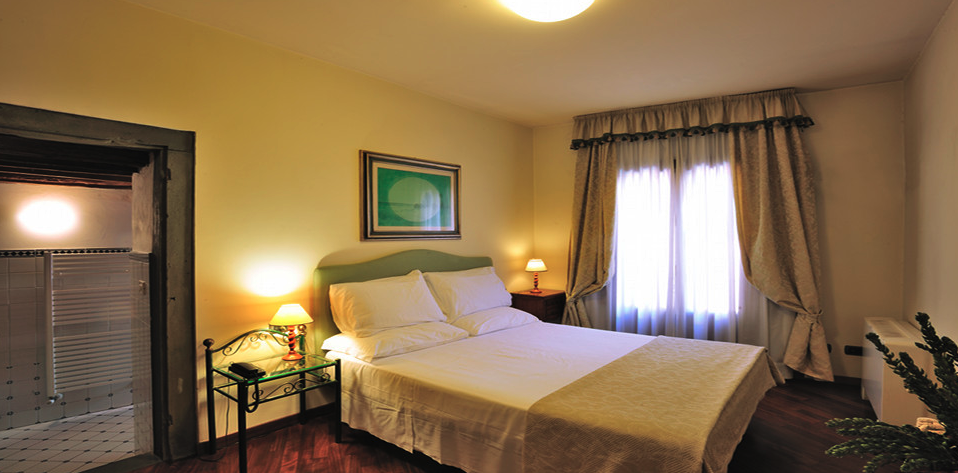

The best thing about Locanda de'Ciompi is its location. It's a very quick ten minute walk to Piazza del Duomo. Located right in the piazza, the hard to miss cathedral of Florence is a good orientation point for getting around. The main streets that you'll take to get to other sights in the city all fan out from the piazza, making it very easy to walk anywhere. From the piazza, it's another ten minutes to get to the Santa Maria Novella train station. This is very convenient if you plan to do a day trip from Florence, or, if you're coming/going and have lots of luggage, it's only a 10-15 Euro cab ride to/from the hotel.


Breakfast was complimentary at the cafe next door and included juice, your choice of a form of caffeine, biscuits, and croissants. Not as much selection as other hotels, but I think everyone shares my sentiment that you'll want to save your calories for dinner, anyway.

Prices fluctuate depending on whether you're visiting in the midst of tourism season or not.

Single room: 50-60 Euros
Double room: 60-85 Euros
Triple room: 90-130 Euros

Rome - Hotel Portoghesi

If you've ever seen Eat, Pray, Love, the scene where Julia Roberts gets out of a cab in Rome for the first time is shot right outside Hotel Portoghesi. Like our Florence hotel, what we liked most about this one was its fabulous location.


Rome can be incredibly confusing at first. It's rather vast and depending on where your hotel is, getting to a certain area for sightseeing can end up being costly or very time consuming. From Hotel Portoghesi, however, we were able to walk to each major area of Rome without much difficulty. It's situated right on the river and takes about 15 minutes to get to the Vatican, 30 minutes to walk to the Colosseum/ruins area (longer if you stop along the way to look at other things) and about 20 minutes to get to the north Rome/Spanish Steps area. You could feasibly walk to the Roma Termini train station as well, but with luggage, we found it easier to take a cab.


The rooms had slightly more charm than those of Milan, but lacked the character of our Florence hotel. The bathrooms were nice as well, and breakfast was average (assortment of carbs in the form of pastries and cereals, various juices, milk, and coffee). Nothing overly spectacular, but again, it's not like we planned to spend our time in the hotel anyway. With Hotel Portoghesi, the price is definitely due to the location.


Single room: 160 Euros
Double room: 200 Euros
Suite: 260 Euros

All bathrooms included complimentary soap, shampoo, and hairdryers.
All hotels charged an extra tax: about 2-3 Euros per person, per night.

Labels: , , , , ,

Sunday, October 20, 2013

Living Abroad: 10 Things I Miss About America

It doesn't take long after moving to a foreign country before you develop a profound appreciation for certain things in your homeland. Some of these are pretty obvious - of course you'll miss your friends and family. Others are a bit more surprising, like things which used to annoy the hell out of you when you had everyday access to them, or things you barely even took notice of. Here are the top 10 (non obvious) things I miss about America, in no particular order.

1. Pumpkins
Around this time of year, America is invaded by armies of orange pumpkins. They find their way into our everyday lives for an entire month via coffees, lattes, breads, pies, cookies, muffins, and of course their original forms, which we promptly cut up and carve hideous faces into. While Italians do celebrate Halloween, I've been really disappointed by the severe lack of pumpkins around here. No pumpkin espressos or pumpkin pizzas. I didn't even see canned pumpkin in the supermarket when, on a whim, I walked in just to look for it. Mind you, it's not so much the literal pumpkin that I miss, it's the cozy fall feeling that you get from drinking a spiced pumpkin latte from Starbucks while you wait for your pumpkin muffins to bake.

2. Football
Growing up and throughout college, I enjoyed football. I was happy when my team won and sad when they lost. That's about it. I was never a die-hard fan, just... a fan. In fact, I recall telling somebody that I didn't think I'd miss American football in Europe. Surprisingly though, I do. I check the Packers Twitter religiously to keep updated on their games and have somehow found myself more emotionally invested in the results than I ever was at home. Like the pumpkin thing, I think it's more the general feeling of watching a game on a crisp fall day with friends that I miss, not literally watching Aaron Rodgers throw a touchdown pass. Either way, I'll be happy when I can refer to football again without having it mistaken for soccer.

3. Sandwiches
Dear God above, I really miss turkey sandwiches. My go-to lunch in America was a turkey, cheddar, avocado and tomato sandwich on wheat bread and I cannot seem to properly duplicate it here in Italy. Yes, the paninis are to die for, and I'm sure I'll miss fresh mozzarella, tomato, and basil on focaccia just as much once I return home. But right now, I'd do just about anything for a pound of sliced deli turkey from Lund's in Minneapolis.

4. Peanut butter
If these were in order, peanut butter just might be number one. I love, love love peanut butter. It is, without a doubt, the food I'd choose if I were stranded on a desert island. Now here I am stranded on a peninsula, and there's hardly any peanut butter to be found. Back at home, a 24 oz jar of Skippy would barely last two weeks with me. Here, I'm reduced to making a little 4 oz jar which cost upwards of 5 Euros last just as long. While I'm grateful I was able to hunt down said 4 oz jar of Skippy, I find myself eternally frustrated that there's nothing larger. They sell Nutella by the gallon for God's sake. WHERE ARE THE MASSIVE PEANUT BUTTERS!?

5. Coffee shops
For two years of college I lived a block away from a lovely little coffee shop. I'd go from time to time when I needed to study or write a paper (though I rarely actually accomplished any studying or paper writing). One of my dear friends would drop in all the time, and now I'm kicking myself for not accompanying her more often. It is literally impossible to locate a coffee shop here, which is frustrating, given the surplus of bars and restaurants that serve cafes round the clock. But a cozy little shop with squashy couches and free Wi-Fi? Nonexistent here. This also ties in with my ongoing battle against Italian coffee espresso. I still haven't formed an appreciation for the stuff, and while I wasn't a huge coffee drinker back home, I'd kill for a large blonde roast from Starbucks right now.

6. Netflix and Hulu
Now I'm sure you're asking yourself, "Why does she want to waste her time watching T.V. shows? She's in Italy, for God's sake!" True, but I'm not vacationing or studying abroad for a short period of time in which I should live it up every waking moment I have. I'm living and working here, I'm exhausted at the end of the day, and sometimes I just want to watch Juan Pablo on the Bachelor, okay!!?? Much to my dismay, Netflix and Hulu are "not available in my region." Thus, I've resorted to cokeandpopcorn.eu (which actually has a massive selection of free T.V. shows), but sadly, they don't have The Bachelor. I guess I'll just have a marathon waiting for me whenever I return home.

7. Free water
In America, I drank water directly from the kitchen sink, and it's free and complimentary at restaurants. Here, I'm told the tap water "isn't always good," (the vagueness is a touch worrisome) and you can expect to pay anywhere from 1-3 Euros for water at a restaurant. Families buy bottled liters of water like we buy milk and refilling a bottle is frowned upon. Now, if the tap water tends to be a bit dirty, fine, I won't drink it all the time. But I can't get behind the whole paying for water in restaurants thing. It's annoying and I miss the days when I could mindlessly bother the waiter for "more water, please."

8. Free (and clean) public restrooms
So you're going out for a day of sightseeing. Not wanting to waste the price of a metro ticket on a glass of water at lunch, you drink your fill before you leave the house. A few hours later you're at the Duomo and need to use the bathroom. First, good luck finding one. Second, be prepared to pay. Third, consider purchasing a home STD test immediately following your use of the restroom. Okay, so all that might be a bit of exaggeration, but let me just say this. Public bathrooms in Europe are few and far between, usually cost a Euro to enter, and aren't the cleanest places on earth. God bless America and our bathrooms that are polished with tax dollars.

9. The U.S. measurement system
Cooking is done in grams, bodies are weighed in kilograms, distance is measured in kilometers, and temperature is recorded in celsius. What? Math has never been my strong suit, so I'm grateful for the conversion app on my iPhone. But it can get a bit tiresome converting cups and tablespoons into grams for a cupcake recipe, wondering if you've gained or lost weight when you step on a scale, and being momentarily freaked out when you check the weather and see it's going to be twenty degrees that day.

10. Target
After much Googling and asking around, I have come to the devastating conclusion that Milan does not have an Italian version of Target. Nowhere in this city does a structure exist that houses fashionable clothing at a reasonable price, home decor that makes you feel like a grown up, and Archer Farms brand food that looks healthy but really isn't. I suppose this is for the best; after all, I don't need any designer Missoni clad fashionistas glaring at me as I walk down Via Montenapoleone in my Target brand Missoni shirt, but still. I miss utter bliss of wasting time in Target with a friend, each of us vowing to stick to our lists but always leaving with a few extra Chobanis, a new mascara, or on those crazy days, a new set of sheets. Target, I think of you often. Know that no matter where in the world I am, you are forever in my heart.

**Edited to add: Problems 1 and 6 have been solved!! A friend in America is sending me a pumpkin spice latte in the mail, and two people have offered solutions to get around my Netflix/Hulu woes. Thanks guys!! :)

Labels: , , , , , , ,

Wednesday, October 16, 2013

Verona: Past and Present

One thing I really loved about Verona is how the past still functions in the present. Many of the historic sites or places have been adapted to fit modern needs while still maintaining their "oldness," so to speak, and there are random bits of historical architecture everywhere you look. For example, Roman and medieval portals - entrances to the city - still stand at random points in the street - though you no longer need to pay the toll in order to pass.


Upon entering the city center through one of these portals, you'll see the ancient Roman arena. Built in 30 A.D. on a piece of land that was, at the time, a few miles outside the Roman city center, its first few centuries of existence saw lots of bloodshed. Gladiator battles pitted man vs. man and man vs. animal in Roman times, and public beheadings took place there during the middle ages. Thanks to a newfound appreciation for the arts cultivated during the Renaissance, the arena started to be used for opera performances. This trend continues today, and it has also seen the likes of One Direction, Duran Duran, The Who, and Whitney Houston. The arena can fit up to 25,000 spectators and as everyone knows, is the blueprint for our modern stadiums. 


The arena's entrance fee is 6 Euros, but if you have a student I.D. that still remotely looks like you and are capable of mumbling "Sono studentessa/o," you can get in for 4.50. Visitors are free to climb up and all over the seats (the lower half of which have had cushions added to them). But... to be completely honest, I was a little disappointed. When it comes down to it, it's just a massive stone complex, and it lacks the romance and intrigue of a well-known arena like Rome's Colosseum. To be fair, it may well have been the horde of teenagers belting out awful Disney songs in Italian on the stage in the center that tainted my arena experience. Oh, and just a friendly hint: those "gladiators" posing with that poor little boy in the above photo are not affiliated with the arena. They're just a local group that prey on tourists by overcharging for a gimmicky photo. Stay away! 

Right outside of the arena is a relatively small, thin column positioned rather randomly in the piazza. 99% of people probably just walk past it without a second thought. It's called a devotional column, and most piazzas had one back in the day (back in the day in this case = middle ages). People would gather around the column to ask for blessings for the market. The one in Verona is still intact, and today people gather around it to gawk at the street performer posted up beneath it, who I strategically did not photograph because I found him frightening. 


Speaking of markets and piazzas, Verona's Piazza Erbe is my favorite piazza I've seen so far. You can make absurd statements like "I have a favorite piazza" when you live in an Italian city. A piazza is just a square, and Italian cities have loads of them. Piazza Erbe is probably one of the few that looks very much like it used to centuries ago. It dates back to the Roman times, when it functioned as a forum - a meeting place for politics and law - and of course, as a marketplace. The fountain in the middle of Piazza Erbe has been bubbling for nearly 2,000 years, and the statue of a lion that sits at the northern end has been there since 1405, when Venice conquered Verona. 


Today, Piazza Erbe is still home to a market of sorts - vendors line up to sell fruits and vegetables, pastries, handmade leather bags, and a few "I visited Verona!!" t-shirts and keychains. You can also find a plethora of tasty restaurants and gelaterias surrounding the square. Here, I found a deliciously cheap sandwich and the first of too many gelatos. 


Do you see that tower in the upper left corner of Piazza Erbe? It's one of the few remaining from the Middle Ages, back when the town was full of them. Noble families built towers to show off their wealth to one another. If you see a bell tower that either stands on its own or is connected to a smaller structure that isn't a church, you can be almost certain it was constructed by an important family. Torre dei Lamberti, or the Lambert Tower (built in 1172), is another that's still standing in Verona, and for 6 Euros you can climb 245 steps to the top. 


Clearly, it's worth the climb. Verona's terra-cotta rooftops seem to go on for miles, and the Italian Alps make for a stunning backdrop. The Lambert Tower sits in the Romanesque Palazzo della Ragione, which is home to yet another beautiful and well-preserved piece of architecture: an outdoor staircase, completely original and intact since its construction in 1447. I stood at the base of the staircase for fifteen minutes to get a photo of it without people strewn all over it. As I watched person after person lay on the banister and pose with freakish arm gestures as if to say, "Yeah, man, look at me! I'm on a staircase, b*tch!" I wondered how many of them even knew anything about what it was they were standing on. In other words, STOP POSING LIKE THAT, YOU'RE DISGRACING THE STONES WHERE VERONA'S ELITE ONCE TROD!! Ugh.


But anyway. Just outside Palazzo della Ragione is Piazza dei Signori, or "The Lord's Square." This little area is a melting pot of architecture; the buildings surrounding it span from the middle ages to the Renaissance. You can easily tell which are from the Renaissance; just look for the frescoes. Like medieval nobles and their towers, wealthy Renaissance families did their bragging with exterior frescoes. I find it pretty remarkable that much of what can be seen today is, for the most part, original and unrestored.  


In the middle of Piazza dei Signori stands a somber looking Dante Alighieri. Quick history: this is indeed the Dante behind The Divine Comedy, the self-narrated tale of his journey through hell and purgatory to reach heaven. It was the first literature to be written in something other than Latin, the language of the church. Dante took a hodgepodge of spoken dialects and called the written result "Italian." For this reason, it was accessible by the masses and wildly popular. It also depicted several well known popes and other church figures in less than flattering situations (Pope Boniface VIII buried up to his head in the 8th circle of hell, for example) and for this reason, Dante was exiled from Florence to Verona, where he lived out the rest of his life. As Dante became a literary genius in history's hindsight, Florentines tried to reclaim him as their hero and even built him a tomb in the 18th century. Verona has maintained a tight grasp on him though, and his body lies not in Florence, but in nearby Ravenna where he died. 


On the topic of tombs, literally right around the corner from Piazza dei Signori are the Scaligeri family tombs. Remember how Florence had the Medici family, Siena had the Borghese, and Milan had the Sforza? When Italy was divided into kingdoms, Verona and the surrounding area had the Scaligeri. Their bodies still lie in the fanciful tombs created for them in the 15th century, which are surrounded by the original wrought iron fences. Not a bad place to rest for all eternity! Just watch out for what looks to be the first version of barbed-wire, though. 


Speaking of resting, this might be enough history for one post. But there's still alot more to see in Verona! Let's spend the night back in Piazza Erbe and pick it up another day, shall we? 


Labels: , , , , , , , , ,

Monday, October 14, 2013

Verona: Introduction


Apparently all of northern Italy's "V" cities are first on my list of places to visit. I started with Venice, Varenna, and Vezia, and am continuing the trend with Verona. I feel as though Verona is often overlooked when people come to Italy. Verona seems to be the "If we have time after we see Florence, Rome, and Venice," destination, like a supporting player for Italy rather than a star. I can't understand why, because in my humble opinion, Verona takes the best of the Big Three and mashes it up into one, easily accessible city. It has the quaint Italian charm of Venice, a smattering of ancient Roman ruins, some Renaissance art to tide you over until you do make it to Florence, and as an added bonus, a good dose of medieval art and architecture. Plus, despite having its fair share of tourist ridden areas, it has a distinct people-actually-live-here vibe to it, making the whole experience feel more authentic. As if all of that isn't enough to lure you in, the city is extremely walkable and all of the main attractions can be seen in one day by foot.


Verona sits east of Milan in northern Italy alongside the Adige River. History wise, the city dates back to around 550 BC. It fell under Roman rule in 300 BC, but due to its strategic position as the intersection of several important ancient roads, who was in charge of Verona changed often. Often as in, all the time. Various Gothic tribes, the Byzantines, and the Lombards ruled the city through the middle ages, and the Italian Scaligeri family took over during the 13th, 14th, and 15th centuries. It was home to Emperor Maxmillian I in the 16th and 17th centuries - oh, and several deadly plague outbreaks. It then became a part of Napoleonic France, then Austria, then France again during Napoleon's conquest of Italy in the 19th century. WWI, WWII and the fascist regime affected Verona as much as it did the rest of Italy; Jews were banned to ghettos and herded off to concentration camps under Mussolini's rule. His son in law, Galeazzo Ciano, was accused of plotting against the republic and was executed on the banks of the Adige River.


Today, churches, monuments, and an abundance of art are all that remain of Verona's tumultuous past, and the city has become a dynamic cultural center. With all that history, there's alot to see, so a trip to Verona really requires some planning. After a bit of research, I ended up organizing my visit based on Rick Steves' 2013 Guide to Italy book, and the end result was near perfection. If you plan on visiting anywhere in Europe, I highly recommend purchasing a Rick Steves guide. If you don't plan on coming to Europe any time soon, I highly recommend you stay far, far away from his books, because just paging through one is enough to make you want to visit. Rick, are you reading? Hi, I'm Emily, and I want to be your protege.


Anyways. Getting to Verona from Milan is easy. You guessed it - take the train. The Verona Porta Nuova station is on the same route that I took to Venice and a ticket is almost twenty Euros cheaper. Once at the station, you can walk about fifteen minutes to the city center, or take a bus for two Euros (or zero, if you just inconspicuously hop in near the back like I did). Once in the city center, I managed to hit all of the major sites in Verona, and occasionally wandered off the beaten path to do some random exploration - all within about six hours. Overall, I was really impressed with everything I saw, although there were a few disappointments. I'll go into details in separate posts later, but here's a quick recap:

1. Piazza Bra and the Roman Arena
2. Piazza Erbe
3. Piazza dei Signori and Torre dei Lamberti
4. Casa di Guilietta
5. Chiesa di Santa Anastasia
6. Verona Duomo
7. Ponte Pietra
8. Castelvecchio
9. Gelato
10. Gelato
11. Again, gelato


All in all, I completely fell in love with Verona today. I suppose that's fitting, given that it's the setting for Shakespeare's ultimate romance, Romeo and Juliet. I returned to Milan with a bit of resentment for the city I'm currently calling home. It certainly has it's own sort of charm, but after spending the day in a history-rich city like Verona, Milan has been feeling more business/industrial/modern than usual. Fortunately, I have a laundry list of museums to tackle (which I've been saving for colder weather), so I'm sure I can get a good dose of history and culture during the week between visiting other cities.

Labels: , , , , ,

Friday, October 11, 2013

Lake Como: Castello di Vezio


The second thing I wanted to make sure I saw in Varenna was Castello di Vezio. Unfortunately, due to my inability to properly read a map, I spent nearly two of my remaining three hours in Varenna walking in circles, trying to locate the start of the trail up to the castle. I had just admitted defeat and decided to spend the last hour or so with a cup of coffee Clooney on the lakeshore when I spotted a small sign with an arrow pointing up a hill. "Mule Trail to Castello di Vezio," it read.

Well, there it was! Just a quick little trot up this mule hill and I'd be standing in the ruins of an ancient castle. I glanced at my watch - I had exactly one hour before I had to catch the train back to Milan. That didn't give me much time in the castle, but I just couldn't leave without seeing it. I figured I would be fine; Rick Steves' Italy guide had mentioned that the trail was an "easy, twenty minute hike," and besides, I was a fast walker.

Well.


This is the first and likely the last time I'll ever say this, but Rick Steves led me astray. While my journey up the mule trail was indeed only twenty minutes, it was easily the worst twenty minute walk of my life. I realized almost immediately that I had a daunting task ahead of me: the hill was quite steep and made of cobblestones, many of which were loose. Even so, this might have been fine - a bit tiring perhaps, but fine - in tennis shoes. But I was wearing a dress and heeled boots. Not ideal hiking attire.

Five minutes into my ascent I was tired and sweating. Ten minutes in I was cursing silently for choosing to wear those boots. Fifteen minutes in and I was now cursing out loud, and the last five minutes were spent stringing profanities into a bleak marching tune.


Finally, I made it. Red faced, sweating, and out of breath, I reached the top of the hill just in time to watch a tour group clamber off a bus that had clearly just driven up the godforsaken hill I just climbed. This castle had better be good, I thought grimly.

Well, the castle itself left a bit to be desired; it was really just remnants of the stone foundation and a bell tower.


But what can you expect from a nearly thousand year old structure? The land on which it was built is documented to have been of strategic importance for the Romans dating back to the 4th century BC. However, evidence of the castle itself doesn't appear in any records until the early 13th century, when Varenna was under seige by Como and its residents took refuge in the castle.


To my untrained eye, I would guess it was built well before that; perhaps around the 9th or 10th centuries, and likely only used as a lookout point or fortress of sorts, not as a residence. In any case, a mere skeleton of what must have been an impressive structure is all that remains today.


What does and always will remain as impressive as ever is the incredible view. Tiny little towns and boats dot the land and the water below, and the Swiss Alps make for a fantastic skyline as you gaze out from behind the crumbling castle walls. If you climb to the top of the tower, it's even better. I gave myself five minutes of uninterrupted, blissful solitude on top of the tower as I took in the view.


I snapped back to reality when I realized I had thirty minutes to descend the treacherous mule trail and get back to the station. I practically ran from the castle to the trail, took a deep breath, and began the dangerous journey. I'm not over exaggerating when I say I rolled both ankles twice and stumbled almost constantly on the way down. It was much more difficult to descend the steep hill in heels and I was strongly considering just taking them off and running down barefoot when I caught sight of a familiar building. I was nearly there. I made it to the train station with a few minutes to spare, only to discover that the train was delayed by about twenty minutes.

So besides wearing comfortable shoes if you visit Varenna and plan to see Castello di Vezio, make sure you have enough time. The view from the top of the tower is really quite incredible and I wish I had given myself a bit longer to enjoy it. I also wish my feet weren't covered in blisters, but hey, sometimes sacrifices must be made.

Labels: , , , , , ,

emilan

emilan