I've just finished
The Pillars of the Earth by Ken Follett. The book is set in 12th century England, during the years of anarchy that came as a result of a dispute over the throne between Empress Maud, the daughter of the dead King Henry I, and her cousin, Stephen. Maud had the support of those who saw her as the true heir - she was, after all, the king's daughter. But Stephen gained support from those who saw Maud as unfit to rule because she was a woman. Blahblahblah, historical ramblings. Anyway, the story follows the lives of various characters and revolves around the building of a cathedral.
That probably sounds extremely dull to most of you.
Admittedly, it even took me a few chapters to really get into it, but I promise you won't be able to put it down if you give it a chance. The characters are masterfully intertwined in surprising ways and you'll find yourself celebrating and commiserating with them as they attempt to finish the cathedral amidst political and religious schemes and strife. What has stuck with me throughout, however, is the silent star of the book - the cathedral itself.
In the past two and a half months I've lost count of the number of cathedrals I've seen. Their size, intricacy, and beauty never fail to leave me in awe. I've literally spent hours making my way down the nave and the aisles, admiring each chapel and seeking out various architectural features I could identify. I have a deep appreciation for cathedrals, but it's always been, for the most part, academic.
Pillars of the Earth has given me a more intellectual appreciation. It's one thing to walk through a cathedral and admire it for purely artistic purposes, or even to feel deeply moved, religiously speaking. But to really
understand how and most importantly,
why these amazing structures were built puts a whole new spin on what you're looking at.
If you looked at Christianity as a line on a graph over the centuries, one of its highest points would be the medieval period. The unshakeable belief in God, heaven, and hell that these people held is the sole purpose for building massive churches. Well, that and the income they could generate for a town, but really, 99.99% of it was driven by religion. The taller the building, the closer to God - people honestly believed that this was true. They also believed that creating something on such an enormous scale specifically
for God would undoubtedly win his favor, thus abolishing their sins and securing their place in heaven. In
Pillars of the Earth, the master builder, Tom, is driven by a deep desire to create the most beautiful cathedral in England, but also very much by his wish to give his wife, who died and is buried in unconsecrated (unholy) ground, a place in heaven.
"My first wife... Agnes... she died without a priest, and she's buried in unconsecrated ground. She hadn't sinned, it was just... the circumstances. I wondered... Sometimes a man builds a chapel, or founds a monestary, in the hope that in the afterlife God will remember his piety. Do you think my design might serve to protect Agne's soul?"
Philip frowned. "....is this design the best thing you could offer God?"
"Except for my children, yes."
"Then rest easy, Tom Builder. God will accept it."
Now, I'm certainly
not the most religious person you'll come across, but even I have to admire how sincerely the people of this time believed. Were it not for that unshakeable faith, I doubt these beautiful churches would ever have been built.
So God accounts for most of the why, what about the how? I'm sure I'm not the only person who has found themselves wondering, "How on earth did people a thousand years ago figure out how to build such structures?" The miracle of it all is made even more apparent by the relative simplicity of our modern buildings in comparison. The answer is simple: years and years and YEARS and DECADES, sometimes CENTURIES of hard labor.
The aptly named Tom Builder in
Pillars of the Earth secures his position as master builder of the cathedral thanks to his knowledge and understanding of masonry and the mathematics of building. The engineers of centuries past were, in many cases, as brilliant and knowledgeable as ours today.
Tom designed the three levels of the nave wall - arcade, gallery and clerestory - strictly in the proportions of 3:1:2. The arcade was half the height of the wall, and the gallery was one third of the rest. Proportion was everything in a cathedral. The tower should be either one and a half times the height of the nave or double it. It would give the building an attractively regular profile, with the aisles, the nave, and the tower rising in equal steps, 1:2:3.
These people understood what would look 'good' and exactly how to implement it; they knew what would allow them to build in a straight line, or create a pointed arch, add windows, or solve difficult problems that often arose while building. They knew and carried out all these things without the aid of our modern technology.
He stood on the scaffolding far above the ground, staring close-range at the new cracks, brooding. He needed to think of a way of bracing the upper part of the wall so that it would not move with the wind. he reflected on the way the lower part of the wall was strengthened. In the outer wall of the aisle were strong, thick piers which were connected to the nave wall by half-arches hidden in the aisle roof. The half-arches and the piers propped up the wall at a distance, like remote buttresses. Because the props were hidden, the nave still looked light and graceful. He needed to devise a similar system for the upper part of the wall....if only he could build piers and half-arches to support the clerestory...
The above passage describes a builder's dilemma regarding the way the height of his cathedral (taller than any other at the time) required additional support, for cracks had been appearing throughout. He needed to add this support without compromising the aesthetic integrity. He later solves the problem by developing flying buttresses - a common feature on many gothic cathedrals. Though the book provides a fictional account of the problem, a similar scenario in real life likely pushed the real inventor of flying buttresses to reach the same conclusion.

Above is the buttressing on Westminster Abbey in London. Each outer pillar reaches a point inside the wall, providing support to the structure. This support isn't enough, however, when cathedrals are built taller. Additional buttressing is required for the upper portions; thus, flying buttresses were utilized, like on Notre Dame in Strasbourg, pictured below. The higher portion of the church is supported by the half arches that jut out and connect to the original lower supports.

Innovations aside, even the most simplistic cathedral could not take shape without the basic materials. Take another look at Westminster Abbey and Notre Dame above; all of that stone had to be quarried by hand and transported to the building site via oxen and carts, then cut with hammers and chisels into hundreds of perfectly shaped pieces for building walls, pillars and arches and sculpting angels, saints, and other decorative pieces. Timber had to be cut from forests and transported to the site as well. As the church grew upwards, wood and stone would be moved from the ground up, piece by piece with pulley systems. There were no cranes, no heavy machinery to assist.
Cathedral building employed hundreds of people and often helped villages prosper into cities. When finished, they would become the churches that held the bishop's throne and often the remains of a particularly important saint. People would flock from all around to hear the bishop say mass or just to kneel at the bones of a saint. There is really no modern day equivalent to describe the sheer importance of the way the people's devotion to God manifested itself in these impressive churches during the Middle Ages.
I suppose that's the point I'm trying to get at here. These buildings weren't created because the town wanted something nice to look at. Cathedrals were built to worship God. Cathedrals were made enormous to please God. Cathedrals were decorated beautifully because God was worthy of only the most glorious of structures. Because of this driving force, the people who lived thousands of centuries ago managed to find innovative techniques to carry out the construction, without the modern technology we use today to create, in my opinion, many less beautiful buildings. I dare you to walk into any European cathedral bearing all of
that in mind and not be at least a bit moved, humbled, and awed at what you're seeing.
So, after this incredibly long introduction, let's take a look at Milan's own cathedral, shall we? Awhile ago I posted about the exterior of the Duomo. It's extravagant, intricate, and beautiful.
The inside is no different. Sadly, I must make a disclaimer here; none of my amateur photography does justice to the sights of Italy, and these photos are certainly no exception. Since you can't use flash inside the cathedral, all of my photos taken with my camera turned out dark, so these are iPhone photos. You get the gist of the place, at the very least. Nothing compares to actually walking inside, anyway.
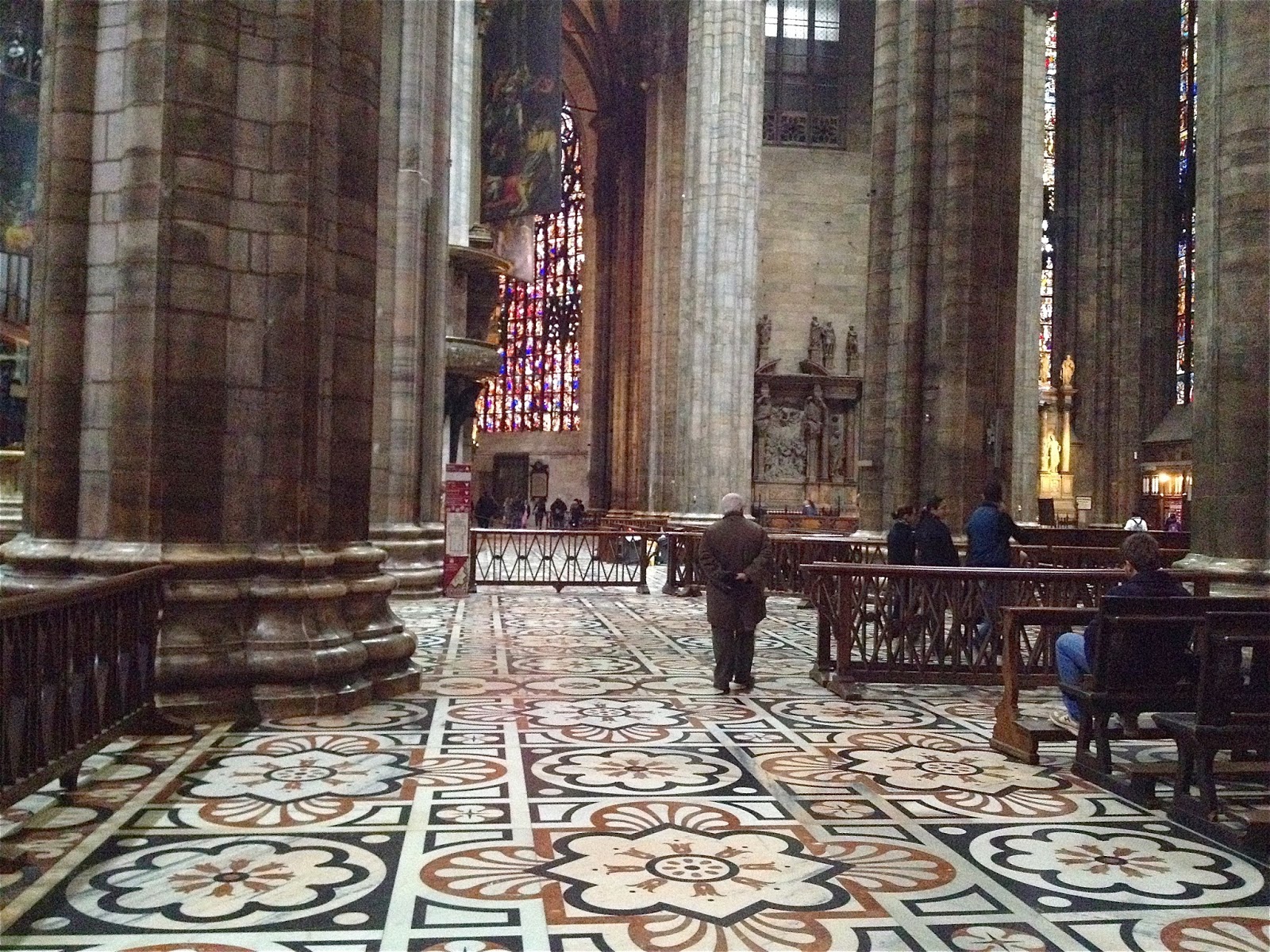
Milan's Duomo boasts rows of massive pillars. Like many Gothic cathedrals, each pillar is surrounded by shafts, giving it a more impressive look overall.
Each pillar is topped off with carved capitals featuring various religious figures.
The shafts that surround each pillar seemingly continue on their way up beneath the decorative capitals and emerge again above them, where they branch off, cross the vault of the nave, and join up with the corresponding shaft from across the way. The square/triangle pattern that results is called a ribbed vault. The very first cathedrals were built with boring barrel vaults - basically just a regular old arched ceiling. Ribbed vaulting was an innovation that allowed cathedrals to be built higher than ever before.
The side aisles of many cathedrals are lined with smaller chapels dedicated to a particular saint or person. Above is a rather large shrine to Saint Something-or-Other, complete with stained glass windows, which were another innovation of Gothic churches.
Size comparison: that random man is barely taller than the base of the pillar.
And like any good Christian church, Milan's Duomo is the final resting place of many esteemed religious men. Yes, these are their real bodies, preserved and enshrined and on display. Rotting popes really liven the place up.
Pictured above is the crypt of San Carlo, the archbishop of Milan in the 16th century. He helped lead the counter-reformation in Italy and became a saint following his death.
It really does make me a bit sad that buildings like this aren't made anymore. The art of cathedral building is about as dead as that pope up there. Fortunately, these churches have stood the test of time and they can still be appreciated today - even more so, when you bear in mind how utterly remarkable it is that they were built in the first place. I'll end this how I started it; cathedrals are awesome, and
Pillars of the Earth is a great book which I highly recommend it to anyone who has even a remote interest in historical fiction. And who knows, it may inspire you to jump the pond real quick and see some European cathedrals for yourself.
Labels: architecture, cathedral, history, Italy, Milan, northern Italy